From San Francisco to Australia
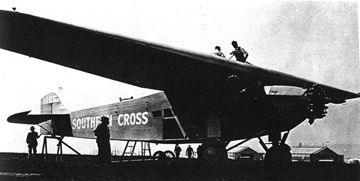
At 8:48 a.m. on May 31, 1928, Australian pilot Charles Kingsford Smith — universally known as "Smithy" — lifted off from Oakland Field on San Francisco Bay in a battered, second-hand Fokker F.VIIb/3m trimotor monoplane he had christened the *Southern Cross*. With him were his co-pilot and business partner Charles Ulm, American navigator Harry Lyon, and American radio operator James Warner. Their objective was audacious: to make the first aerial crossing of the Pacific Ocean, a feat that many experts considered impossible and that local Californian bookmakers had placed at odds of eleven to one against their even reaching Hawaii, since ten aviators had perished the previous year attempting just the first leg of the Pacific crossing.
The aircraft itself had a remarkable pedigree — it had begun life as the *Detroiter*, an Arctic exploration plane that had crashed in Alaska in 1926 during an expedition led by the Australian polar explorer Hubert Wilkins. Kingsford Smith bought the wreck, had the original engines replaced with three new Wright J-5 Whirlwind radials and the fuel capacity increased to 1,267 gallons. To lighten the load, the crew sat on wicker chairs that were not bolted to the floor.
The noise of the three Wright Whirlwind engines was deafening — so much so that the crew were forced to communicate with each other by messages scribbled on scraps of paper. The flight was made in three legs across a total distance of approximately 7,300 miles. The first stage, from Oakland to Wheeler Army Airfield in Hawaii, covered 2,400 miles and took an uneventful 27 hours and 25 minutes. After repairs to the starboard engine and a brief rest at the Royal Hawaiian Hotel, the crew took off again on June 3 for the most dangerous leg of the journey: the 3,155-mile crossing to Suva, Fiji.
This was the most demanding portion of the journey, as they flew through a massive lightning storm near the equator. Blinding rain lashed the cockpit, the instruments became unreliable, and at one terrifying point the engines sputtered for eight agonizing minutes before roaring back to life over the empty Pacific. After 34 hours and 30 minutes in the air, they landed at Albert Park in Suva — the *Southern Cross* becoming the first aircraft ever to land in Fiji.
By the time they reached Fiji, the crew were stone deaf from the engine noise and had no idea what the welcoming party said, observing only the waving arms and open mouths of the crowd. The final leg of the flight covered 1,795 miles, concluding at Eagle Farm Airport in Brisbane on June 9, 1928, after 21 hours and 35 minutes in the air. A crowd of 25,000 gathered to witness the arrival of the pioneering crew. The total flying time across the three legs was approximately 83 hours.
Kingsford Smith and Ulm became instant national heroes — when the *Southern Cross* continued on to Sydney the following day, a crowd estimated at 300,000 turned out to greet them, and a police cordon had to form around the plane as it taxied to prevent the excited crowd from rushing into the propellers. The achievement made Kingsford Smith the most celebrated aviator in the Southern Hemisphere and one of the most famous in the world.
He was knighted in 1932. He and Ulm went on to accomplish a series of additional firsts — the first nonstop flight across Australia, the first trans-Tasman crossing to New Zealand, and eventually a circumnavigation of the globe. But both men's lives ended in tragedy: Ulm was killed in December 1934 when his plane disappeared near Hawaii, and Kingsford Smith died when his plane crashed off the coast of Burma in November 1935. Sydney's international airport bears his name today, and the *Southern Cross* is preserved in a glass hangar memorial at Brisbane Airport — a monument to the age when crossing an ocean in a fabric-covered airplane powered by three 220-horsepower engines required not only extraordinary skill but a kind of courage that is difficult to comprehend in the modern era.