USS Macon Crash
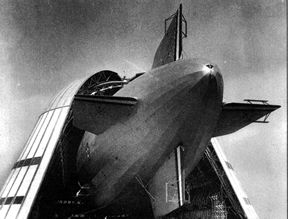
The USS Macon was one of the United States Navy's two giant rigid airships, a flying aircraft carrier designed to scout for the fleet and to launch and recover its own small Sparrowhawk fighter planes in mid-air. Filled with non-flammable helium, the Macon represented the Navy's ambitious vision of long-range aerial reconnaissance.
On February 12, 1935, the Macon was caught in turbulent weather off Point Sur on the California coast. A structural failure in the tail, aggravated by earlier damage, led to a loss of control, and the great airship settled into the Pacific. Most of the crew survived thanks to life jackets and rafts, but the airship itself was lost.
The destruction of the Macon, coming after the earlier loss of her sister ship Akron, effectively ended the U.S. Navy's program of large rigid airships. The crashes convinced the Navy that the enormous, fragile dirigibles were too vulnerable to weather to be practical, and naval aviation turned decisively toward fixed-wing aircraft and carriers.