Ford Trimotor Introduced
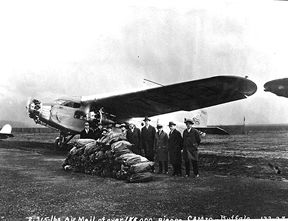
The Ford Trimotor and the Birth of Commercial Aviation in America When Henry Ford unveiled the Ford Trimotor in 1926, the world of aviation was barely two decades removed from Kitty Hawk. Flight was still widely regarded as a stunt — a dangerous novelty pursued by daredevils and military men, not something a sensible businessman or traveling family would consider. Into this atmosphere of public skepticism, Ford launched an aircraft that would begin to change minds, reshape the American transportation landscape, and plant the seeds of the commercial aviation industry that would come to define the twentieth century.
The Origins of the Trimotor Henry Ford's entry into aviation did not begin with the Trimotor. In 1925, Ford acquired the Stout Metal Airplane Company, founded by the innovative designer William Bushnell Stout, whose earlier "Air Pullman" had demonstrated that all-metal construction could produce a viable passenger aircraft. Ford saw in Stout's work something that aligned perfectly with his industrial philosophy: aviation, like the automobile, needed to be made reliable, repeatable, and accessible.
The Tin Goose, as the Trimotor quickly came to be known, was the product of that conviction. The aircraft that emerged from Ford's Dearborn, Michigan plant drew heavily on the design principles of the German Junkers aircraft — particularly the use of corrugated duralumin skin, which gave the plane its distinctive rippled appearance and exceptional structural strength for the era. Ford's engineers refined and Americanized these concepts, producing an aircraft with a high-wing monoplane configuration, fixed landing gear, and — most crucially — three air-cooled radial engines.
This triple-engine arrangement was not mere excess. It was a direct response to the public's terror of mechanical failure over the open landscape of America. With three engines, the Trimotor could continue flying even if one failed entirely, a reassurance that proved enormously important in marketing the aircraft to both airlines and anxious passengers. Construction and Design The Trimotor's all-metal construction set it sharply apart from the fabric-and-wood biplanes that still dominated aviation in the mid-1920s.
Its corrugated aluminum skin, while aerodynamically imperfect by later standards, was extraordinarily robust and resistant to the stresses of repeated flight in an era when aircraft routinely encountered violent turbulence, ice, and rough landing strips. The high-wing design gave passengers an unobstructed view downward — a feature that was marketed as a luxury but was also, more practically, a result of the structural demands of the metal airframe.
The cabin, by the cramped and noisy standards of the day, was considered almost spacious. Early models seated between eight and twelve passengers in wicker chairs — wicker being chosen specifically for its light weight. The interior was loud, cold, and vibrated with the thunder of three Wright Whirlwind or Pratt & Whitney Wasp engines, but by 1926 standards this was civilized travel. Flight attendants — then called stewards or cabin boys — were not yet a fixture on American routes, but the Trimotor was laid out with at least the aspiration of passenger comfort in mind.
A small lavatory was sometimes included. Windows offered views of the American landscape passing below at the then-thrilling speed of approximately 130 miles per hour. Ford's Industrial Might and the Airplane What gave the Trimotor a significance beyond its engineering specifications was the identity of its manufacturer. Henry Ford was, in 1926, the most famous industrialist in the world. His Model T had already put America on wheels; the notion that the same mind and the same factory discipline might now put America in the air carried enormous cultural weight.
Ford's involvement in aviation sent a signal to the American public that flying was not reckless adventure but rational progress — the natural extension of the automotive revolution that had already transformed the country. Ford promoted the Trimotor with the same relentless energy he had applied to the automobile. He established the first scheduled airmail and passenger service operated by a manufacturer, flying routes connecting Detroit, Cleveland, and Chicago.
Ford Airport in Dearborn became the site of the first paved airport runway in the United States, another Ford contribution to the infrastructure of commercial aviation. Ford Air Transport Service, launched alongside the Trimotor, gave Americans a glimpse of what regular, scheduled air travel might look like — not as a military exercise or an airshow spectacle, but as a routine service. The Airlines Embrace the Tin Goose The commercial airlines of the late 1920s seized upon the Trimotor as the aircraft that could make their businesses viable.
Transcontinental Air Transport — later to become TWA — used Fords on its ambitious transcontinental routes, which combined rail travel at night with air travel during the day. Passengers would board a train in New York, switch to a Ford Trimotor at a stop along the route, and continue westward through the American sky, arriving in Los Angeles after a journey measured in days rather than weeks. TAT marketed this service as the "Lindbergh Line," invoking the hero of the 1927 transatlantic flight to lend glamour to what was still an unsettling experience for most travelers.
Pan American Airways used the Trimotor on early Latin American routes. National Air Transport and Maddux Air Lines operated Trimotors on California and transcontinental routes. United Air Lines, in its formative years, flew Fords alongside other aircraft. By the late 1920s, the Trimotor was as close to a standard commercial airliner as the American market possessed, a workhorse whose three engines and metal construction made it the most trusted aircraft available for carrying paying passengers.
The Trimotor in Exploration and History Beyond the scheduled airline routes, the Ford Trimotor wrote itself into history in more dramatic ways. Commander Richard Byrd used a Ford Trimotor — the Floyd Bennett — for the first flight over the South Pole on November 29, 1929, one of the great feats of exploration aviation. The aircraft carried Byrd and his crew over the Antarctic wastes in conditions of extreme cold and altitude that tested the Trimotor to its limits and demonstrated that all-metal construction could endure environments far beyond the sunny skies of commercial routes.
The Trimotor also appeared in the earliest barnstorming and air circus culture, carrying passengers on short hops for the price of a ticket at county fairs and rural airfields across the country. These flights — brief, thrilling, and accessible to ordinary Americans — did perhaps as much as any scheduled airline service to familiarize the public with the experience of flight. For millions of Americans in the late 1920s and early 1930s, their first time in an airplane was aboard a Ford Trimotor buzzing low over the fields and towns of rural America.
Limitations and Decline The Trimotor's reign was not destined to last long in the fast-moving world of 1920s and 1930s aviation. The corrugated aluminum skin that gave the aircraft its strength also created significant aerodynamic drag, limiting its speed and fuel efficiency. The fixed landing gear, appropriate for the rough grass strips of the mid-1920s, became an increasing liability as aerodynamics improved. Passenger comfort, while acceptable by 1926 standards, lagged behind what travelers increasingly expected as the decade progressed.
The introduction of the Boeing 247 and, most decisively, the Douglas DC-2 and DC-3 in the early 1930s rendered the Trimotor commercially obsolete almost overnight. These sleek, streamlined all-metal monoplanes with retractable landing gear carried more passengers faster and more economically than the Tin Goose could manage. Ford's aircraft division, never a central focus of the company the way the automobile business was, was shuttered in 1933 after a production run of 199 aircraft.
The Great Depression had devastated airline revenues, and Ford, facing its own pressures, saw little reason to continue developing aircraft that were now clearly a generation behind the state of the art. Legacy Yet the Ford Trimotor's legacy far outlasted its production run. It established the template for American commercial aviation during the critical years when the industry was finding its footing — years when public confidence was fragile and a single catastrophic crash could set back the cause of commercial flight by a decade.
The Trimotor's three-engine design, its all-metal construction, and above all the credibility that Ford's name lent to the enterprise helped move aviation from the realm of spectacle into something approaching normalcy. Several Ford Trimotors survive to this day, a testimony to the durability of that corrugated aluminum construction. The Experimental Aircraft Association and various aviation museums operate flyable examples that continue to carry passengers, making the Trimotor one of the oldest airworthy commercial aircraft types still in service — a living connection to the moment when America first seriously imagined taking to the skies as a nation.
When passengers climb aboard one of these survivors and hear those three radial engines cough to life, they hear the sound of 1926: the moment an industrialist from Michigan looked up at the sky and decided it was time to build something that could fill it.