Earhart — First Woman to Cross the Pacific
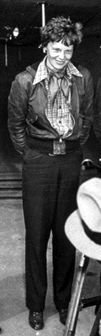
On January 11, 1935, at 4:44 p.m. local time, Amelia Earhart gunned her crimson Lockheed Vega 5C down the rain-soaked grass runway at Wheeler Field on Oahu, Hawaii, carrying 500 gallons of fuel and headed for the mainland United States — a 2,408-mile crossing of open Pacific Ocean that had already killed ten pilots who attempted it. The flight took her 600 more miles over water than Charles Lindbergh's famous transatlantic crossing Fox News — eighteen hours and sixteen minutes of flying alone through the night over a featureless ocean, navigating by the stars and a compass, with nothing but water beneath her from the moment Diamond Head disappeared behind the wing until the California coast materialized through the fog the following afternoon.
She climbed above rain squalls, fought through fog banks off the coast, and during the final hours of the flight tuned in a broadcast of the Metropolitan Opera from New York to break the monotony. Pulling up over a notch in the coastal hills, she beheld San Francisco Bay before her, and six minutes later she set down on the runway of Oakland Municipal Airport Vintage Aviation News at 1:31 p.m. Pacific Time on January 12, 1935, becoming the first person — man or woman — to fly solo from Hawaii to the North American mainland.
A crowd of approximately 10,000 people was on hand to celebrate her arrival. Vintage Aviation News She surprised them all by making a straight-in approach rather than the expected flyover. When someone offered her a chair, she declined: "No, thank you — I've been sitting ever since I left Honolulu." The Hawaii-to-California flight cemented Earhart's place as the foremost aviator of her era, regardless of gender. She had already become the first woman to fly solo across the Atlantic in May 1932, earning a Distinguished Flying Cross — the first ever awarded to a woman.
Now she had conquered the Pacific as well, demonstrating that the vast ocean could be bridged by a single pilot in a single-engine airplane and blazing the trail for the commercial air routes she knew would inevitably follow. "I wanted the flight just to contribute," she wrote afterward. "I could only hope one more passage across that part of the Pacific would mark a little more clearly the pathway over which an air service of the future will inevitably ply." Later that year, Earhart made record flights from Los Angeles to Mexico City and from Mexico City to Newark, New Jersey, and placed fifth in the 1935 Bendix Race.
Pioneers of Flight She was, by any measure, the most accomplished and famous pilot in America. But the Pacific was not finished with Amelia Earhart. Two years later, on July 2, 1937, she and navigator Fred Noonan vanished over the South Pacific during an attempt to circumnavigate the globe, somewhere between New Guinea and tiny Howland Island — a speck of coral barely two miles long and eighteen feet above sea level. Her last radio transmission, received by the Coast Guard cutter Itasca at 8:43 a.m., reported she was on a line of position but could not locate the island.
Neither she, nor Noonan, nor the Lockheed Electra was ever found. The mystery of her disappearance has never been solved, but it has never dimmed the achievement of that January night in 1935, when a woman alone in a red monoplane flew through the darkness above the Pacific and landed safely on the other side.