Bell X-1 Breaks the Sound Barrier
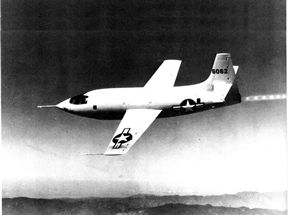
On the morning of October 14, 1947, Captain Charles "Chuck" Yeager of the United States Army Air Forces climbed into the cockpit of a sleek, rocket-powered experimental aircraft designated the Bell X-1 — which he had named Glamorous Glennis after his wife — in the bomb bay of a specially modified Boeing B-29 Superfortress high above the Mojave Desert at Muroc Army Air Field in California. What made the flight particularly remarkable was that Yeager had cracked two ribs in a riding accident two nights earlier and had told almost no one, concerned that he would be removed from the flight if the injury became known.
He had quietly consulted a civilian doctor off-base and fashioned a workaround for the pain with the help of his fellow pilot Jack Ridley, who rigged a short piece of broomstick to help Yeager secure the cockpit door with his damaged right side. At an altitude of 20,000 feet the B-29 released the X-1, Yeager ignited the rocket engine, and the bright orange aircraft climbed toward 42,000 feet. At approximately Mach 1.06 — a speed of 670 miles per hour — the needle on the Mach meter jumped off the scale, and the flight instruments of the chase planes watching from below registered something that no human being had ever produced before: a sonic boom rolling across the California desert, proof that the so-called sound barrier had been broken.
The achievement had been the subject of fierce debate and genuine scientific uncertainty in the years leading up to it. Many aeronautical engineers had worried that the region around Mach 1 — where shock waves built up dramatically around an aircraft's surfaces — represented a physical barrier that no aircraft and no pilot could survive, and the deaths of several test pilots attempting to push toward transonic speeds in conventional aircraft had given the concern deadly credibility.
The Bell X-1's design addressed the problem directly, modeling its fuselage on the shape of a .50 caliber bullet — which was already known to be stable at supersonic speeds — and equipping it with a rocket engine rather than a conventional jet to provide the necessary thrust in the thin air at extreme altitude. Yeager's successful flight, kept secret by the military for several months before being announced to the public, opened the supersonic age and set American military and commercial aviation on a trajectory of rapidly accelerating performance that within a decade would produce aircraft capable of flying at more than three times the speed of sound.
Yeager himself went on to a legendary career as a test pilot and Air Force officer, and when journalist Tom Wolfe immortalized the culture of test flying in his 1979 book *The Right Stuff*, it was Yeager — laconic, fearless, and possessed of an almost preternatural physical gift for flying — whom he identified as the original embodiment of that ineffable quality.