Planes Collide Over New York
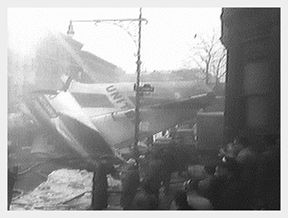
On December 16, 1960, a United Airlines Douglas DC-8 jet and a TWA Lockheed Super Constellation collided in heavy snow over the borough of Staten Island and Brooklyn, New York, in the deadliest aviation disaster in American history to that point, killing all 128 people aboard both aircraft and an additional six people on the ground when the stricken DC-8 plunged into the Park Slope neighborhood of Brooklyn. The DC-8 had been approaching Idlewild Airport while the Super Constellation was descending toward LaGuardia, and the collision occurred when the jet, flying too fast and too far beyond its cleared airspace, strayed into the Constellation's flight path at approximately 5,000 feet over Staten Island.
There was a single survivor — eleven-year-old Stephen Baltz of Wilmette, Illinois, who was thrown clear of the wreckage of the DC-8 when it struck the ground on Sterling Place in Brooklyn and who lived for one day before dying of his injuries, long enough to tell rescuers that he had looked out the window and seen "a city of white rooftops" in the snow before the impact. The Brooklyn collision was the second catastrophic mid-air disaster in American skies in four years — the first having occurred on June 30, 1956, when a United Airlines DC-7 and a TWA Constellation collided over the Grand Canyon in Arizona, killing all 128 people aboard both aircraft in what was then the deadliest aviation accident in history.
Together the two disasters exposed the fundamental inadequacy of the United States air traffic control system, which had been built around the assumption that pilots could see and avoid each other — a system adequate for the relatively slow piston-engine aircraft of the 1930s and 1940s but catastrophically ill-suited to the jet age, where aircraft flew faster, higher, and in far greater numbers than the original system had been designed to handle.
The Grand Canyon collision had already prompted congressional hearings and the creation of the Federal Aviation Agency in 1958, but the Brooklyn disaster demonstrated with devastating finality that the reforms enacted in the wake of the earlier crash had not gone nearly far enough. Congress responded to the December 1960 collision by accelerating the overhaul of the national air traffic control system, mandating radar surveillance of all aircraft operating in controlled airspace, establishing strict transponder requirements, and investing in the computer-based traffic management infrastructure that forms the foundation of the modern ATC system.
The wreckage of the DC-8 in Park Slope — which destroyed a church, a pillar factory, and several brownstones and left the quiet Brooklyn neighborhood strewn with aviation debris and the personal effects of the dead — served as a visceral, neighborhood-scale reminder that the price of an inadequate air traffic control system was not paid only by those aboard the aircraft but by everyone living beneath the increasingly crowded skies of the jet age.