Tupolev TU-104 Introduced
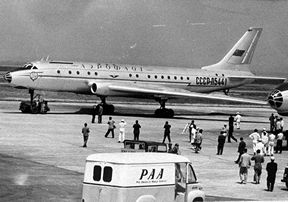
On June 17, 1955, test pilot Yu. L. Alasheyev lifted a strange new aircraft off the runway at the Tupolev design bureau's test facility outside Moscow — an airplane that looked, from certain angles, almost exactly like the Tu-16 "Badger" strategic bomber that NATO had been nervously tracking over Soviet airspace for the past two years. It was, in fact, very nearly the same airplane. The design request was filled by the Tupolev OKB, which based their new airliner on its Tu-16 "Badger" strategic bomber.
The wings, engines, and tail surfaces of the Tu-16 were retained, but the new design adopted a wider, pressurized fuselage designed to accommodate 50 passengers. The decision to build a commercial airliner by grafting a passenger cabin onto a proven bomber airframe was characteristically Soviet — brutal, pragmatic, and fast. Andrei Tupolev's engineers kept the Badger's swept wings, its twin Mikulin AM-3 turbojet engines (mounted in the wing roots, not on pylons), its landing gear, and its tail assembly, and simply replaced the bomb bay and weapons systems with a pressurized tube full of seats, a galley, and a lavatory.
The result was the Tupolev Tu-104, the first Soviet jet airliner and only the second jet passenger aircraft in the world to enter commercial service, after the British de Havilland Comet. The West got its first look at the Tu-104 in March 1956, when Khrushchev's delegation arrived in London aboard one — the British were stunned to discover that the Soviets had a functioning jet airliner at a time when their own Comet was grounded after a series of catastrophic crashes caused by metal fatigue.
On September 15, 1956, the Tu-104 began revenue service on Aeroflot's Moscow–Omsk–Irkutsk route, replacing the piston-engined Ilyushin Il-14. The flight time was reduced from 13 hours and 50 minutes to 7 hours and 40 minutes. The Tu-104 was the sole jetliner operating in the world between 1956 and 1958 — a fact the Soviet propaganda apparatus exploited relentlessly as proof of Communist technological superiority. The Tu-104's bomber DNA, however, made it a difficult and sometimes dangerous aircraft to fly.
The Tu-104 was considered difficult to fly, as it was heavy on controls and quite fast on final approach, and at low speeds it would display a tendency to stall, a characteristic of the highly swept wings it had inherited from the Badger — wings designed to penetrate enemy airspace at high speed, not to loiter gently onto a runway at 140 knots with passengers aboard. Tu-104 pilots were trained on the Il-28 bomber, followed by mail flights on an unarmed Tu-16 bomber painted in Aeroflot colors — a training pipeline that would have been unimaginable in the West, where airline pilots were not expected to have first learned their trade in nuclear-capable bombers.
The aircraft suffered a series of fatal crashes throughout its service life, many caused by the stall characteristics and the difficulty of managing the swept-wing aerodynamics at low altitude. Despite these problems, 201 Tu-104s were built in several variants (seating between 50 and 115 passengers), and in civilian service, the Tu-104 carried over 90 million passengers with Aeroflot, then the world's largest airline. By 1957, Aeroflot had placed the Tu-104 on international routes to London, Paris, Brussels, Copenhagen, Beijing, Delhi, and Ottawa — showing the Soviet flag at airports across the world.
Czechoslovak Airlines became the first carrier in the world to operate an all-jet route, flying Tu-104As between Prague and Moscow. The aircraft was finally retired from Aeroflot passenger service in 1979 and from military transport duty in 1981 — a quarter-century career for a machine that had been, at its core, a strategic bomber with curtains on the windows. The Tu-104's successors — the Tu-124, Tu-134, and Tu-154 — gradually shed the bomber heritage and became genuine airliners, but none of them carried the sheer audacity of the original: the idea that you could take an airplane designed to deliver nuclear weapons to NATO capitals and instead fill it with fifty passengers, a flight attendant, and a samovar, and call it progress.