Stratocruiser Goes Into Service
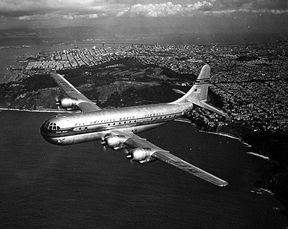
On April 1, 1949, Pan American World Airways inaugurated commercial service with the Boeing 377 Stratocruiser, launching the new aircraft on its San Francisco to Honolulu route across the Pacific — one of the most demanding overwater passages in commercial aviation, demanding both range and reliability in equal measure. The Stratocruiser was the most luxurious and technologically sophisticated commercial airliner of its era, a massive double-decked aircraft derived from the military C-97 Stratofreighter, which had itself been developed from the B-29 Superfortress bomber.
Powered by four enormous Pratt and Whitney Wasp Major 28-cylinder radial engines — the most powerful piston engines ever installed on a commercial airliner — the Stratocruiser could carry up to 100 passengers in its pressurized main cabin, while a spiral staircase in the forward fuselage led down to a lower-deck cocktail lounge that became the aircraft's most celebrated feature. For passengers accustomed to the cramped, unpressurized airliners of the prewar era, stepping aboard a Stratocruiser was an experience that seemed to belong to a different world entirely — a world of club chairs, white tablecloths, and sleeping berths on overnight routes that made transcontinental and transoceanic flying feel less like an ordeal and more like an occasion.
Pan American was the launch customer and most enthusiastic operator of the Stratocruiser, and the aircraft became closely identified with the airline's aspirational image as the carrier of choice for the wealthy and the glamorous in the final years before the jet age. United Airlines, Northwest Airlines, BOAC, and several other carriers also operated the type, and on routes such as New York to London and San Francisco to Honolulu the Stratocruiser set a standard of airborne comfort that would not be surpassed until the wide-body jets of the late 1960s arrived.
Yet the aircraft had a troubled operational history that somewhat tarnished its glamorous reputation: the Wasp Major engines were notoriously unreliable, with propeller failures a recurring concern on the overwater routes where engine trouble could be fatal, and the Stratocruiser suffered a disproportionate number of accidents relative to its contemporaries. Only 56 aircraft were built — a commercially disappointing total that reflected both the high price of the aircraft and the engine reliability concerns — and the type was rapidly retired when the Boeing 707 entered service in the late 1950s.
Nevertheless, the Stratocruiser occupies an honored place in aviation history as the pinnacle of the piston-engine airliner era, the last great expression of a school of aircraft design that the jet engine was about to render permanently obsolete.