Gigantic Spruce Goose Flies
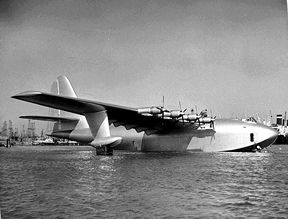
The origins of the Spruce Goose lay in the desperate strategic circumstances of early 1942, when German U-boats were sinking Allied merchant shipping in the Atlantic at a catastrophic rate and American military planners were searching urgently for ways to move troops and supplies across the ocean without exposing them to submarine attack. Howard Hughes, already celebrated as one of America's premier aviators and a major aircraft manufacturer, partnered with the industrialist Henry Kaiser — the man who had revolutionized shipbuilding with his mass-production Liberty Ship program — to propose a solution of breathtaking ambition: a flying boat so enormous that it could carry 700 fully equipped troops or two Sherman tanks in a single transatlantic crossing, flying safely above the submarine threat.
The project was approved and funded jointly by the government and the two partners, but Kaiser withdrew from the venture in 1944, unwilling to commit further to an aircraft that showed no sign of nearing completion. Hughes pressed on alone, pouring $7 million of his own fortune into the project alongside the $17 million in government funding, and directed his engineers to work in aluminum-scarce wartime conditions using a laminated birchwood construction technique — a material choice that earned the aircraft its dismissive nickname, the Spruce Goose, a name Hughes despised.
By the time the H-4 Hercules was complete, the war it had been designed to help win had been over for two years, and Hughes faced a congressional investigation led by Senator Owen Brewster that accused him of war profiteering and misuse of government funds. It was in the charged atmosphere of that investigation — with Hughes's reputation and business empire under direct attack — that he announced he would personally fly the aircraft in November 1947.
On November 2, with journalists and officials aboard for what was described as a taxi test, Hughes surprised everyone by pushing the throttles of all eight Pratt and Whitney engines to full power and lifting the 300,000-pound aircraft off the surface of Long Beach Harbor for a flight of approximately one mile at 70 feet altitude and 135 miles per hour — just long enough and just high enough to prove that his critics had been wrong.
The flight lasted less than a minute, and the Spruce Goose never flew again. Hughes kept the aircraft in a climate-controlled hangar at his own expense for the remaining twenty-nine years of his life, refusing to allow it to be scrapped or displayed, as if the act of preserving it was itself a form of vindication. It is now the centerpiece of the Evergreen Aviation and Space Museum in McMinnville, Oregon, where its extraordinary dimensions continue to astonish visitors — a magnificent, impractical, and uniquely American monument to the power of obsession and the refusal to be told that something cannot be done.