Mirage Unveiled
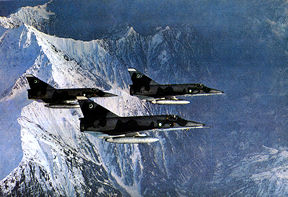
**The Dassault Mirage: France's Supersonic Marvel** On June 25, 1955, Marcel Dassault unveiled the prototype of what would become one of the most celebrated fighter aircraft in the history of European aviation — the Mirage, a sleek delta-wing supersonic interceptor that announced France's arrival as a first-rank producer of advanced military aircraft in the postwar era. The Mirage's most distinctive feature was its tailless delta wing configuration — an equilateral triangle of a wing that provided exceptional structural strength, a large internal fuel volume, and outstanding performance at high speeds and high altitudes, while simplifying the aircraft's construction and reducing its radar cross-section.
Powered by a single SNECMA Atar afterburning turbojet, the Mirage was capable of exceeding Mach 2 — twice the speed of sound — and climbing to an operational ceiling of 57,000 feet, placing it firmly among the most capable fighters of its generation. Marcel Dassault, born Marcel Bloch into a Jewish family in Paris in 1892, had survived deportation to Buchenwald concentration camp during World War II, and his postwar determination to rebuild his aircraft company and make it a world leader produced a family of aircraft — beginning with the Ouragan and Mystère before reaching its apogee with the Mirage — that transformed the French aviation industry and made France the world's most successful exporter of military aircraft outside the two superpowers.
The Mirage's combat reputation was made permanently and dramatically during the Six-Day War of June 1967, when Israeli Air Force Mirage IIICJs proved devastatingly effective in the air superiority role, achieving kill ratios against Egyptian, Syrian, and Jordanian aircraft that astonished military observers worldwide. Israeli pilots, flying with exceptional skill and tactical sophistication, used the Mirage's speed, ceiling, and maneuverability to establish air superiority over the battlefield within hours of the war's opening strikes, and the aircraft's performance in that conflict generated export orders from dozens of nations and cemented the Mirage family's reputation as the premier Western alternative to American fighters for air forces operating on restricted budgets.
The Mirage went on to see combat in the Falklands War of 1982 — where Argentine Mirages faced British Sea Harriers in the South Atlantic — in multiple Middle Eastern conflicts, and in various African wars, accumulating a combat record across four decades that few aircraft of any nationality have matched. The delta wing configuration that Dassault pioneered in the Mirage proved so successful that it was retained and refined through successive generations of the aircraft, from the Mirage III through the Mirage V, Mirage F1, and Mirage 2000, and its aerodynamic DNA lives on in the Rafale — the current frontline fighter of the French Air Force — which continues the tradition of excellence that Marcel Dassault established when he unveiled his swept-wing masterpiece on that June day in 1955.