Soviets Introduce the MiG-15
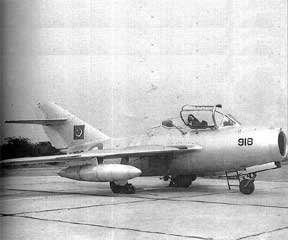
In 1948, the Soviet Union unveiled the Mikoyan-Gurevich MiG-15, a swept-wing jet fighter that stunned Western military analysts and fundamentally altered the balance of air power in the early Cold War. The aircraft bore the unmistakable influence of wartime German aeronautical research — its 35-degree swept wing configuration derived directly from the same captured German data that had informed Boeing's B-47 Stratojet — but the Soviet engineers Artem Mikoyan and Mikhail Gurevich synthesized those borrowed concepts with remarkable speed and skill into an aircraft that was genuinely formidable in its own right.
The MiG-15's development received an unexpected boost from an unlikely source: in 1947 the British Labour government, in a gesture of commercial goodwill that would later be regarded as one of the more consequential foreign policy miscalculations of the postwar era, sold the Soviet Union 55 Rolls-Royce Nene turbojet engines — among the most advanced jet engines in the world at the time. Soviet engineers promptly reverse-engineered the Nene into the Klimov VK-1 engine that powered the MiG-15, giving the aircraft a thrust-to-weight ratio and climb performance that placed it on par with the best Western fighters of the period.
When the MiG-15 entered service with Soviet Air Forces in 1949 it represented a quantum leap beyond anything the USSR had previously fielded in the air. The MiG-15's true impact became devastatingly apparent when it appeared over the skies of Korea in November 1950, flown initially by Soviet pilots under Chinese and North Korean markings in what both sides tacitly agreed to treat as a fiction. American pilots flying the straight-winged F-80 Shooting Star and F-84 Thunderjet found themselves suddenly and shockingly outclassed, and the United States rushed the swept-wing F-86 Sabre into the theater in response, producing the first jet-versus-jet air combat in history in the airspace over northwestern Korea that American pilots called MiG Alley.
The two aircraft proved broadly comparable, with the MiG-15 holding advantages in ceiling and climb rate while the F-86 was more maneuverable at lower altitudes and equipped with superior gunsights and avionics. The MiG-15's appearance in Korea also confirmed what Western intelligence had suspected but not fully credited: that Soviet aviation technology had caught up to the West far more rapidly than anyone had anticipated, driven by a combination of captured German research, purloined Western technology, and the formidable indigenous engineering talent of the Mikoyan-Gurevich design bureau.
The MiG designation that first achieved global notoriety with the MiG-15 went on to define Soviet and Russian military aviation for the remainder of the twentieth century, through the MiG-17, MiG-19, MiG-21, and beyond — a lineage that began with the swept silver fighter that first appeared over the Yalu River and sent a shock of alarm through every air force in the Western alliance.