F-104 Makes Its Debut
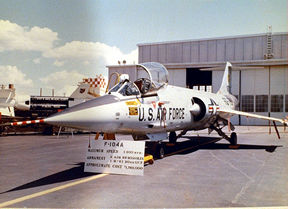
On January 7, 1954, Lockheed unveiled the XF-104 Starfighter at its Burbank, California facility, introducing the world to an aircraft of such radical design philosophy that it looked unlike anything that had preceded it in the history of fighter aviation. The Starfighter was the creation of Lockheed's legendary designer Clarence "Kelly" Johnson — the same genius behind the U-2 spy plane and the SR-71 Blackbird — who had visited Korea during the war and listened carefully to American fighter pilots describing what they wanted in their next aircraft: something faster, simpler, and capable of climbing and accelerating away from any threat the Soviets could put in the sky.
Johnson's response was an aircraft of almost brutal minimalism, built around the most powerful engine available — the General Electric J79 afterburning turbojet — and stripped of every ounce of unnecessary weight and drag. The result was a machine of startling appearance: an extraordinarily slender fuselage barely wide enough to accommodate its pilot, stubby razor-edged wings so thin and sharp that ground crews required special protective covers to avoid being cut by them, and a T-shaped tail that gave the aircraft its unmistakable silhouette.
Capable of reaching Mach 2 — twice the speed of sound, or approximately 1,320 miles per hour at altitude — the F-104 was the first operational fighter in the world to sustain that performance level, earning it the dramatic nickname "the missile with a man in it." The F-104 entered United States Air Force service in 1958 and went on to become one of the most widely exported Western fighters of the Cold War era, serving with the air forces of more than a dozen nations including West Germany, Italy, Canada, Japan, the Netherlands, and Taiwan.
Its career, however, was marked by a controversy as sharp as its wing edges: the F-104's extraordinary performance came at a significant cost in handling characteristics, particularly at low speeds and high angles of attack, where the aircraft's tiny wings provided minimal lift and recovery from unusual attitudes was extremely difficult. The West German Luftwaffe's experience with the Starfighter became particularly notorious — German pilots flew the aircraft in the low-altitude, all-weather strike role for which it was poorly suited, and between 1961 and 1989 Germany lost 292 of its 916 F-104s in accidents, along with 116 pilots, earning the aircraft the grim nickname "the Widowmaker" in the German press.
The scandal over German F-104 losses, which eventually implicated Lockheed in payments to foreign officials to secure export contracts, contributed to the passage of the U.S. Foreign Corrupt Practices Act of 1977. Despite its troubled safety record in certain roles, the F-104 Starfighter remains one of the most visually striking and aerodynamically uncompromising aircraft ever built — a machine that pursued pure performance with a single-mindedness that produced both brilliance and tragedy in equal measure.