DC-7 Introduced
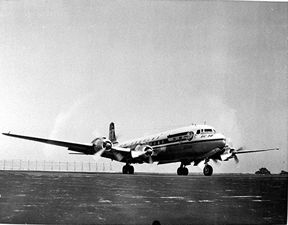
On May 18, 1953, Douglas Aircraft introduced the DC-7, the final and most refined expression of the great piston-engine airliner lineage that Douglas had been developing since the legendary DC-3 of the 1930s. The DC-7 was a direct descendant of the DC-6, sharing its general configuration but featuring a stretched fuselage capable of accommodating up to 105 passengers, and powered by four Wright R-3350 Turbo-Compound engines — the same innovative power plants that had been fitted to the Super Constellation — which extracted additional power from exhaust gases through turbines coupled to the crankshaft, producing 3,400 horsepower per engine and giving the aircraft a performance edge over its predecessors.
American Airlines was the launch customer, having pushed Douglas to develop the type in response to TWA's acquisition of the Lockheed Super Constellation, and the competitive pressure between the two airlines drove Douglas to deliver a product that would match and surpass what Lockheed had produced. Three distinct variants were developed in rapid succession: the baseline DC-7 for domestic transcontinental service, the DC-7B with additional fuel capacity for longer overwater routes, and the definitive DC-7C Seven Seas — the most capable commercial piston airliner ever built — which entered service with Pan American in 1956.
The DC-7C represented the absolute pinnacle of piston-engine airliner development and achieved something that had eluded all of its predecessors: the ability to fly nonstop across the North Atlantic in both directions, regardless of prevailing winds, without the fuel stops that had made eastbound and westbound crossings asymmetrical in their demands. Its extended wingspan carried additional fuel, and its Turbo-Compound engines provided the range and reliability needed for the 3,000-plus mile crossing against the notoriously punishing westerly headwinds that had forced earlier aircraft to make refueling stops in Iceland or Newfoundland.
Yet the DC-7C's moment of dominance was extraordinarily brief — Pan American placed its first order for the Boeing 707 jet airliner in the same year the DC-7C entered service, and when the 707 began transatlantic service in 1958 it rendered the piston-engine airliner obsolete almost overnight, cutting crossing times in half and offering a smoothness and reliability that no propeller-driven aircraft could match. The DC-7C that had been state of the art in 1956 was cascading to secondary carriers and cargo roles by the early 1960s, a commercial lifespan of barely five years for an aircraft that represented the culmination of three decades of piston-engine airliner development.
Douglas produced 338 DC-7s across all variants, and the type stands in aviation history as a magnificent final chapter — the last word written in a tradition of aircraft design that the jet engine had permanently superseded.