B-47 Enters Service
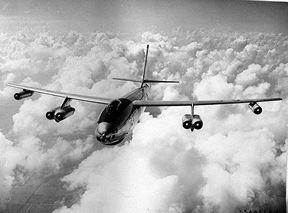
On December 17, 1947 — the 44th anniversary of the Wright Brothers' first flight at Kitty Hawk, a date the Boeing company almost certainly chose with deliberate symbolism — the prototype Boeing B-47 Stratojet lifted off for the first time from Boeing Field in Seattle, Washington, inaugurating a new era in military aviation. The aircraft that took to the air that morning was unlike anything that had preceded it in the bomber lineage: a sleek, graceful machine powered by six General Electric turbojet engines mounted in pods beneath and ahead of its wings rather than buried within them, with a needle nose, a bubble canopy for its crew of three, and — most radically of all — wings that swept back at a dramatic 35-degree angle from the fuselage.
The swept-wing configuration had been pioneered theoretically by German aeronautical engineers during World War II, and American engineers had absorbed that research through captured documents and interviews with German scientists after the war. Applied to the B-47, the swept wing allowed the aircraft to fly at speeds approaching Mach 0.9 — faster than any bomber previously built and faster than many contemporary fighter aircraft — while its clean, aerodynamically refined design gave it a performance envelope that seemed to belong to the future rather than the late 1940s.
The B-47 Stratojet entered operational service with Strategic Air Command in 1951 and went on to be produced in extraordinary numbers — 2,040 aircraft delivered across multiple variants — making it the backbone of American nuclear deterrence through the 1950s and into the early 1960s. Its influence on subsequent aircraft design was incalculable: the swept wing, podded engines, and general configuration that Boeing developed for the B-47 flowed directly into the Boeing 707 commercial jetliner and the B-52 Stratofortress, both of which owe their essential character to the lessons learned in designing and flying the Stratojet.
The aircraft was not without its challenges — it required a runway of exceptional length for takeoff, often needed jet-assisted takeoff rockets to get airborne when fully loaded with fuel and weapons, and had handling characteristics that demanded considerable skill from its crews — but its combination of speed, range, and payload capacity made it a genuinely revolutionary weapon system. When the B-47 was retired from front-line service in the early 1960s, superseded by the longer-ranged B-52 it had helped inspire, it left behind an American aerospace industry permanently transformed by the aerodynamic principles it had been the first to demonstrate at operational scale.