707 Service Across the Atlantic
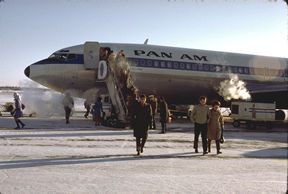
On the evening of October 26, 1958 departing late at night and arriving in Paris on October 27 Pan American World Airways Flight 114, operated by a gleaming Boeing 707-121 named Clipper America, lifted off from Idlewild Airport in New York and pointed its nose across the Atlantic toward Paris, inaugurating the era of scheduled transatlantic jet passenger service and changing the world of travel irrevocably and permanently. The flight carried 111 passengers in a cabin that was quieter, smoother, and more comfortable than anything they had experienced on a piston-engine airliner, cruising at approximately 35,000 feet and 550 miles per hour in conditions far above the weather systems that had made Atlantic crossings in propeller aircraft an ordeal of turbulence and noise.
The crossing took approximately eight and a half hours roughly half the time required by the fastest piston-engine airliners then in service and when the Clipper America touched down at Paris Orly Airport, it had not merely completed a flight but had closed one chapter in the history of transportation and opened another. Pan American's visionary president Juan Trippe had spent years working toward this moment, negotiating aircraft orders, routes, and landing rights with the methodical determination of a man who understood that jet travel would not merely accelerate existing patterns of transatlantic movement but would create entirely new ones, bringing Europe within the reach of middle-class American travelers for the first time and transforming the Atlantic from an obstacle into a highway.
The significance of the Clipper America's inaugural flight extended far beyond the 111 passengers who experienced it firsthand. Within months of Pan Am's launch, every major international airline was scrambling to introduce jet service on the Atlantic, and the cascade of orders for 707s, DC-8s, and the British de Havilland Comet 4 which had actually beaten the 707 to transatlantic service by three weeks, with BOAC operating the first jet Atlantic crossing on October 4, 1958 transformed the order books of aircraft manufacturers and the route structures of airlines simultaneously.
The price of transatlantic air travel fell steadily as jet economics replaced piston economics, and the number of people crossing the Atlantic by air for the first time exceeded those crossing by sea within two years of the Clipper America's inaugural flight — a crossover that marked the definitive end of the great ocean liner era and the beginning of the age of mass international air travel that has since carried billions of people across the world's oceans.
Idlewild Airport itself was renamed John F. Kennedy International Airport in 1963, but the runway from which the Clipper America departed on that October evening in 1958 had already earned its place in history as the point of departure for one of the most consequential commercial flights ever made.