Boeing Unveils the 707
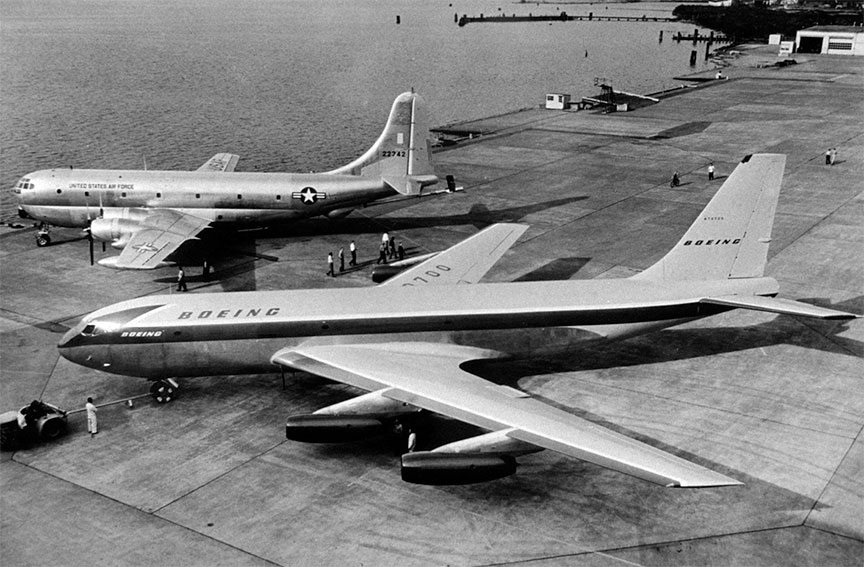
On July 15, 1954, Boeing's prototype jet transport — initially designated the Model 367-80, universally known as the Dash 80 — took to the air for the first time from Boeing Field in Seattle on a maiden flight of approximately 90 minutes, piloted by Boeing's chief test pilot Alvin "Tex" Johnston. The aircraft that lifted off that summer morning represented a gamble of almost reckless magnitude by Boeing's leadership, who had committed $16 million of the company's own money — roughly equivalent to its entire net worth at the time — to develop a jet transport prototype without a single firm order in hand, betting that the future of commercial aviation belonged to the jet and that Boeing needed to be first with a viable aircraft or cede the market to Douglas and Lockheed permanently.
The Dash 80 was a swept-wing, four-engine jet of clean, modern design that bore a clear family resemblance to the B-47 and B-52 bombers Boeing had already developed, benefiting from the aerodynamic and structural lessons learned in building those aircraft. The 90-minute maiden flight confirmed that Boeing's engineers had gotten the fundamental design right, and the company began the process of developing the prototype into the production aircraft that would be offered to the airlines as the Boeing 707 — stretched, widened, and refined from the Dash 80 to accommodate up to 181 passengers in a configuration that would transform the economics and experience of long-distance air travel.
The 707 entered commercial service with Pan American World Airways on October 26, 1958, inaugurating transatlantic jet service between New York and Paris and in doing so rendering every piston-engine airliner in the world obsolete almost overnight. The aircraft that had taken four days to carry 36 passengers across the Atlantic in the Boeing 314 flying boat of 1939 now carried 181 passengers in six and a half hours, and the effect on commercial aviation was as transformative as any development in the industry's history — more people flew in the decade after the 707 entered service than had flown in all the preceding decades of commercial aviation combined.
Pan American's early 707 orders were followed by virtually every major airline in the world, and the type spawned a family of variants — the short-range 707-120, the intercontinental 707-320, and the transcontinental domestic 707-120B — that collectively sold more than 1,010 airframes to commercial customers, with a further 820 military KC-135 Stratotanker variants built on the same basic airframe bringing the total production of Boeing's landmark jet transport family to well over 1,800 aircraft.
The aerodynamic configuration that Boeing established with the 707 — low swept wing, podded underwing engines, pressurized wide-body fuselage — became the template for virtually every commercial jet airliner built in the seven decades since, making the Dash 80's 90-minute maiden flight on July 15, 1954, one of the most consequential test flights in the history of aviation.