McDonnell Douglas KC-10 Extender
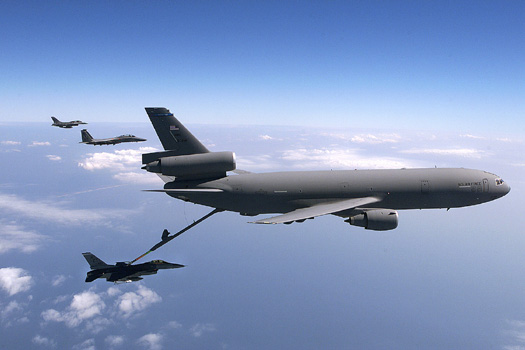
The KC-10 Extender was a three-engine aerial tanker and cargo aircraft, a military development of the McDonnell Douglas DC-10 widebody airliner (production was later carried on by Boeing). Designed to give U.S. forces greater global mobility, it combined the roles of tanker and transport, able to refuel fighters in flight while simultaneously carrying their support personnel and equipment. Entering service in 1981, it retained about 88 percent commonality with the DC-10 but added military avionics, a refueling boom and a hose-and-drogue system, a boom operator station, an in-flight refueling receptacle and additional fuel tanks beneath the cargo floor.
The KC-10 could carry roughly 170,000 pounds of cargo or some 356,000 pounds of fuel, nearly twice the offload of the KC-135. It played a major role in Operations Desert Shield and Desert Storm and the 1999 Allied Force campaign. The fleet was retired in 2024.
Specifications
- Manufacturer
- McDonnell Douglas (later Boeing)
- Type
- Aerial-refueling tanker and transport
- Crew
- 4 (pilot, co-pilot, flight engineer, boom operator)
- First Flight
- July 12, 1980
- Powerplant
- 3 x General Electric CF6-50C2 turbofans, 52,500 lbf each
- Max Speed
- 619 mph (Mach 0.825)
- Range
- Approx. 4,400 mi (3,800 nm) with cargo; 11,500 mi without cargo
- Service Ceiling
- 42,000 ft (12,727 m)
- Length
- 181 ft 7 in (54.4 m)
- Wingspan
- 165 ft 4.5 in (50.4 m)
- Loaded Weight
- Max takeoff 590,000 lb (267,620 kg)