Lockheed F-94 Starfire
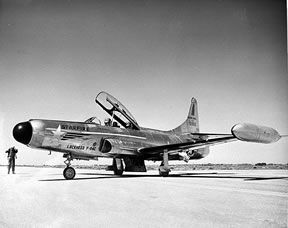
The Lockheed F-94 Starfire was an early jet all-weather interceptor and the first U.S. Air Force fighter to enter service with an afterburner. Developed quickly from the two-seat T-33 trainer, itself a derivative of the F-80 Shooting Star, the Starfire added a radar in the nose and a radar operator behind the pilot to give Air Defense Command a night- and bad-weather fighter at the start of the 1950s. The prototype first flew in 1949, and the type saw combat in the Korean War, becoming the first American jet all-weather fighter to fight there.
Early F-94A and B models used the Allison J33 and carried machine guns; the heavily revised F-94C Starfire adopted the more powerful Pratt & Whitney J48 and an all-rocket armament. Built by Lockheed, the Starfire bridged the gap between wartime piston interceptors and the dedicated supersonic interceptors that would follow later in the decade.
Specifications
- Manufacturer
- Lockheed
- Type
- All-weather interceptor
- Crew
- 2 (pilot and radar operator)
- First Flight
- 1949
- Powerplant
- Allison J33 turbojet with afterburner (F-94A/B)
- Max Speed
- 606 mph
- Range
- 1,079 miles
- Service Ceiling
- 48,000 ft
- Length
- 40 ft 1 in
- Wingspan
- 38 ft 11 in
- Loaded Weight
- 12,919 lb
- Armament
- 4 x .50 cal machine guns (F-94A/B); rockets (F-94C)