Vought F-8 Crusader
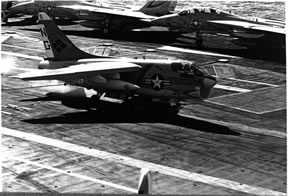
The Vought F-8 Crusader was a carrier-based supersonic air superiority fighter that served the U.S. Navy and Marine Corps from the late 1950s through the Vietnam War. First flown in March 1955, it was the Navy's first operational fighter capable of 1,000 mph and won the Collier Trophy for its achievement. Its most distinctive feature was a variable-incidence wing that pivoted upward on takeoff and landing, raising the angle of attack while keeping the fuselage and pilot's view level.
Powered by a single Pratt & Whitney J57 afterburning turbojet, it relied chiefly on four 20mm cannon plus Sidewinder missiles, earning the nickname "the last of the gunfighters." Crusader pilots scored a favorable kill ratio against North Vietnamese MiGs, and photo-reconnaissance RF-8 variants flew critical missions including over Cuba in 1962. About 1,260 were built, serving into the 1980s with the U.S. and into the 1990s with France.
Specifications
- Manufacturer
- Vought
- Type
- Carrier-based fighter
- Crew
- 1
- First Flight
- March 25, 1955
- Powerplant
- 1 x Pratt & Whitney J57-P-20A turbojet, 18,000 lbf with afterburner
- Max Speed
- Mach 1.86 (approx. 1,225 mph)
- Range
- 1,735 miles (ferry)
- Service Ceiling
- 51,500 ft
- Length
- 54 ft 3 in
- Wingspan
- 35 ft 8 in
- Loaded Weight
- 34,000 lb (max)
- Armament
- 4 x 20mm cannon plus AIM-9 Sidewinder missiles