LTV A-7 Corsair II
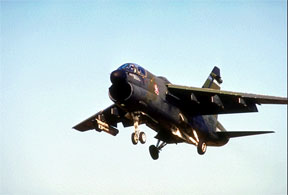
The LTV (Ling-Temco-Vought) A-7 Corsair II was a subsonic, single-seat carrier-based attack aircraft developed for the U.S. Navy as a replacement for the A-4 Skyhawk. Derived from the supersonic F-8 Crusader but redesigned with a shorter fuselage and emphasis on payload and range over speed, it first flew on September 27, 1965, and entered combat in Vietnam in 1967. Early Navy versions used the Pratt & Whitney TF30 turbofan, while later A-7D and A-7E models adopted the more powerful Allison TF41, a license-built Rolls-Royce Spey.
The Corsair II carried a heavy bomb load with notable accuracy thanks to an advanced navigation and weapons-delivery system. Flown by both the Navy and Air Force, it served through Vietnam, the 1986 strikes on Libya, and Operation Desert Storm before retirement in the early 1990s.
Specifications
- Manufacturer
- LTV (Ling-Temco-Vought)
- Type
- Carrier-based attack aircraft
- Crew
- 1
- First Flight
- September 27, 1965
- Powerplant
- One Allison TF41-A-2 turbofan (A-7E), 15,000 lb thrust
- Max Speed
- 690 mph
- Range
- 1,070 nmi combat radius (ferry range much greater)
- Service Ceiling
- 42,000 ft
- Length
- 46 ft 1 in
- Wingspan
- 38 ft 9 in
- Loaded Weight
- 42,000 lb max takeoff
- Armament
- One 20mm M61 Vulcan cannon; up to 15,000 lb of bombs and missiles on six hardpoints