Boeing XP-9
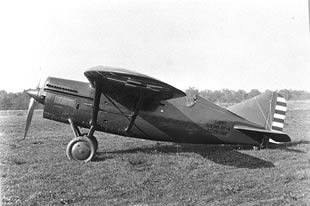
The Boeing XP-9 (company Model 96) was the first monoplane fighter designed by Boeing, marking the firm's transition away from the biplane pursuits that had made its reputation. A single-seat, shoulder-wing monoplane with fixed landing gear, it featured a semi-monocoque metal fuselage and a braced, fabric-covered wing. Power came from a 600 hp supercharged Curtiss V-1570 Conqueror liquid-cooled engine. The XP-9 first flew on 18 November 1930, but the thick wing mounted directly ahead of the cockpit badly obstructed the pilot's downward view, making even routine landings hazardous.
Although it reached 213 mph, the Army Air Corps was sufficiently dissatisfied that it declined to order the type into production and did not exercise its option for service-test Y1P-9s. The XP-9 was nonetheless an important step in Boeing's evolution toward the all-metal monoplane fighters that would follow.
Specifications
- Manufacturer
- Boeing Aircraft (Model 96)
- Type
- Experimental monoplane fighter
- Crew
- 1
- First Flight
- 18 November 1930
- Powerplant
- 1 x 600 hp Curtiss V-1570 Conqueror V-12 (supercharged)
- Max Speed
- 213 mph
- Range
- 425 mi
- Service Ceiling
- 26,800 ft
- Length
- 25 ft 1 in
- Wingspan
- 36 ft 6 in
- Loaded Weight
- 3,623 lb (gross)