Dayton-Wright PS-1
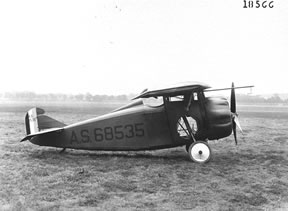
The Dayton-Wright PS-1 (designation 'PS' for 'Pursuit, Special'; sometimes listed as XPS-1) was an experimental single-seat parasol-monoplane fighter built by the Dayton-Wright Airplane Company for the U.S. Army Air Service. It was conceived around 1921-1922 in response to an Army requirement for a lightweight 'alert' interceptor able to climb quickly to meet intruders. The aircraft had wooden flying surfaces and a fabric-covered steel-tube fuselage, and was powered by a small air-cooled radial engine driving a wooden propeller.
Three prototypes were ordered and flight-tested at McCook Field, but the design proved unsatisfactory and was rejected in late 1922; it never entered production. The PS-1 is significant mainly as an early U.S. monoplane fighter experiment during the transition from wartime biplanes. The existing hint specs are broadly consistent; max speed is more reliably about 145-146 mph.
Specifications
- Manufacturer
- Dayton-Wright Airplane Company
- Type
- Experimental pursuit monoplane
- Crew
- 1
- First Flight
- 1922
- Powerplant
- 1 x Lawrance J-1 air-cooled radial, ~200 hp
- Max Speed
- ~145 mph
- Range
- ~237 mi
- Service Ceiling
- 26,700 ft
- Length
- 19 ft 2 in
- Wingspan
- 30 ft
- Loaded Weight
- ~1,715 lb gross
- Armament
- 2 x .30 in machine guns