Curtiss CR-3
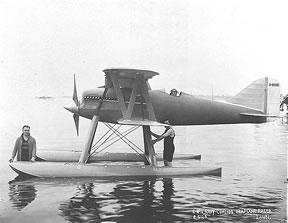
The Curtiss CR-3 was a single-seat racing biplane developed by Curtiss for the U.S. Navy and is best remembered for winning the 1923 Schneider Trophy. The CR series began as landplane racers (CR-1 and CR-2); for the 1923 Schneider contest, held at Cowes, England, the two aircraft were converted to twin-float seaplanes, fitted with roughly 475 hp Curtiss D-12 engines and fitted with forged aluminum propellers in place of wooden ones.
On 28 September 1923 Lieutenant David Rittenhouse flew a CR-3 to victory at about 177 mph, with the second CR-3 finishing close behind, marking the first time the United States won the prestigious international seaplane race. One of the aircraft later set a world closed-course seaplane speed record of about 188 mph. The CR-3 demonstrated the aerodynamic and engine advances, especially the streamlined D-12 powerplant, that would shape Curtiss fighters of the decade.
Specifications
- Manufacturer
- Curtiss
- Type
- Racing seaplane (biplane)
- Crew
- 1
- First Flight
- 1921 (as CR-1); CR-3 conversion 1923
- Powerplant
- 1 x ~475 hp Curtiss D-12 V-12
- Max Speed
- 194 mph
- Length
- 25 ft
- Wingspan
- 22 ft 8 in
- Loaded Weight
- 2,746 lb (gross)