Comet — First Commercial Jet
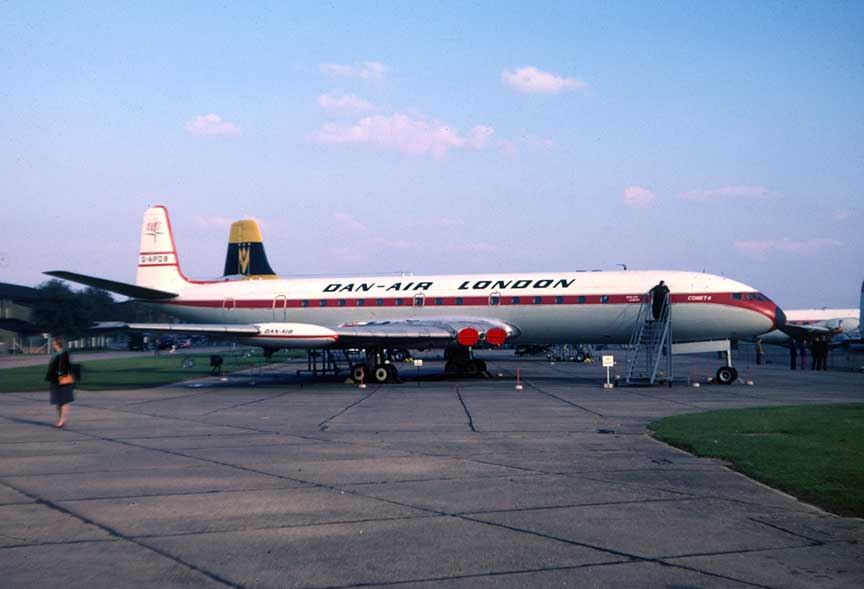
On July 27, 1949, the de Havilland DH.106 Comet made its maiden flight from Hatfield Aerodrome in Hertfordshire, England, lifting off into history as the world's first jet-powered commercial airliner and announcing with unmistakable clarity that aviation had entered a fundamentally new era. The aircraft that de Havilland had designed was a machine of striking elegance — a sleek, low-wing monoplane with four de Havilland Ghost turbojet engines buried cleanly within the wing roots rather than slung in external pods, giving it a pure, uncluttered silhouette that looked unlike anything previously seen in commercial service.
Capable of carrying 36 passengers at a cruising speed of 490 miles per hour at altitudes up to 40,000 feet, the Comet offered a flying experience that was qualitatively different from anything the piston-engine era had provided: smooth, quiet, vibration-free travel above the weather at speeds that reduced journey times by half or more. When the Comet entered scheduled service with British Overseas Airways Corporation on May 2, 1952 — the first jet airliner service in history — it was greeted with genuine wonder, and Britain basked in the prestige of having beaten the Americans to the commercial jet age by what appeared to be a comfortable margin.
The triumph proved devastatingly short-lived. A series of catastrophic in-flight breakups beginning in 1953 and culminating in two crashes in early 1954 — the losses of BOAC Flight 781 near the island of Elba in January and South African Airways Flight 201 near Naples in April — forced the grounding of the entire Comet fleet and triggered one of the most thorough and consequential accident investigations in the history of aviation.
The inquiry, led by the Royal Aircraft Establishment at Farnborough, eventually identified the cause as metal fatigue propagating from the corners of the Comet's square passenger windows — a phenomenon that the aviation industry had not yet fully understood or designed against. The repeated pressurization and depressurization cycles of high-altitude flight were slowly cracking the fuselage around the window cutouts until the hull failed explosively at altitude, destroying the aircraft in an instant.
The Comet was redesigned with oval windows and a strengthened fuselage and returned to service in 1958, but the years lost to grounding and investigation had allowed Boeing to develop the 707 and Douglas the DC-8, and Britain never recovered its early lead in commercial jet aviation. The Comet's legacy is thus bittersweet: a genuine pioneer whose early disasters taught the entire industry lessons about pressurized airframe design that made every subsequent jet airliner safer, its sacrifice purchased at the cost of the passengers and crews who perished in those catastrophic breakups over the Mediterranean.