U-2 Tested
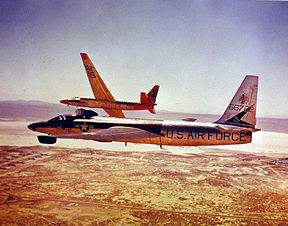
The U-2 — designated with the deliberately bland "U" for "utility" to disguise its true purpose — was built at Johnson's semi-secret Skunk Works division in Burbank, California, and tested at a remote, restricted facility on a dry lake bed in the Nevada desert that would later become known as Area 51. The work hours were long — sixty to seventy per week — and secrecy demanded that not only design features but even the very existence of the project be kept from everyone, including family members.
Johnson's design was a masterpiece of engineering compromise: to save weight and maximize altitude, the aircraft used a bicycle-style landing gear (two sets of wheels in tandem along the fuselage, with detachable outrigger wheels on the wings that fell away on takeoff), carried no armor or weapons, and was built so lightly that pilots joked it was held together by faith and Kelly Johnson's temper. The enormous 80-foot wings gave the U-2 the glide ratio of a sailplane, which made it extraordinarily fuel-efficient at high altitude but murderously difficult to land — pilots had to fly the aircraft to a near-stall just feet above the runway while a chase car driven by a fellow pilot called out altitudes over the radio.
CIA officials began training pilots to fly the U-2 in the spring of 1956, and by the summer, the first models of the jet, the U-2A, became operational. On July 4, 1956, a U-2A completed the first overflight of the Soviet Union. Over the next four years, U-2 aircraft flew routinely from bases in Pakistan, Turkey, Germany, and Japan, photographing vast stretches of Soviet territory from altitudes above 70,000 feet with cameras that could resolve objects as small as two and a half feet from thirteen miles up.
These flights gathered much important data and particularly revealed that the so-called "missile gap" in the Soviets' favor was a myth, thus altering the delicate strategic balance. As CIA Director Richard Helms later said: "Building the U-2 was absolutely the smartest decision ever made by the CIA. It was the greatest bargain and the greatest triumph of the Cold War." Approximately 90 percent of the hard intelligence the United States possessed about Soviet military capabilities in the late 1950s came from U-2 cameras.
Chapman University + 3 The U-2's charmed existence ended on May 1, 1960, when CIA pilot Francis Gary Powers was shot down by a Soviet SA-2 surface-to-air missile over Sverdlovsk (now Yekaterinburg) while flying at 70,500 feet. The Eisenhower administration initially claimed that a NASA "weather research plane" had gone missing near the Turkish border — a cover story that collapsed spectacularly when Soviet Premier Nikita Khrushchev revealed that Powers had survived, that the Soviets had recovered the wreckage, and that they had the developed film from the camera.
The incident torpedoed a planned summit between Eisenhower and Khrushchev in Paris and became one of the most embarrassing diplomatic crises of the Cold War. Powers was tried in Moscow, convicted of espionage, and sentenced to ten years in prison; he was exchanged in February 1962 for Soviet spy Rudolf Abel on the Glienicke Bridge in Berlin — a scene later dramatized in Steven Spielberg's Bridge of Spies (2015). But the U-2's most consequential mission was yet to come.
In 1962, during the Cuban Missile Crisis, a U-2 took photographs that confirmed the presence of Soviet nuclear-armed missiles in Cuba — the intelligence that gave President Kennedy the evidence he needed to confront Khrushchev and demand the missiles' removal, bringing the world to the brink of nuclear war and then, thirteen harrowing days later, back from it. During the crisis, Major Rudolf Anderson Jr. was shot down and killed over Cuba on October 27, 1962, becoming the only combat casualty of the crisis and the first U-2 pilot killed by enemy fire.
A tactical reconnaissance version, the TR-1A, first flew in August 1981 and was structurally identical to the U-2R. The TR-1 designation was later dropped, and all variants reverted to the U-2 name. Remarkably, over its long service life the U-2 has periodically faced competition from other intelligence-gathering systems — for instance, Earth-orbiting satellites or the supersonic SR-71 Blackbird spy plane — but intelligence and military services consistently have found it useful because of its operational flexibility, excellent aerodynamic design, and adaptable airframe.
The U-2 has outlived its supposed replacement, the SR-71 Blackbird (retired in 1998), and as of 2026 continues to fly operational missions for the United States Air Force more than seventy years after Tony LeVier's unintended first flight over the Nevada desert — making it one of the longest-serving aircraft in the history of military aviation, and a monument to Kelly Johnson's genius for building machines that refuse to become obsolete.