Lockheed Introduces the YC-130
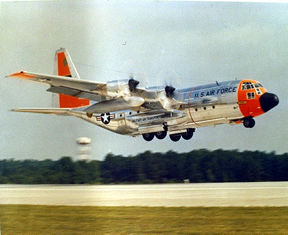
On August 23, 1954, the prototype Lockheed YC-130 Hercules made its maiden flight from Lockheed's facility in Burbank, California, piloted by Stanley Beltz and Roy Wimmer, inaugurating the career of what would prove to be the most versatile, durable, and successful military transport aircraft in the history of aviation. The Hercules had been designed in response to a 1951 United States Air Force requirement for a tactical transport capable of operating from unprepared airstrips in forward combat areas — a lesson drawn directly from the Korean War, where the inability to deliver troops and supplies to rough, short runways had repeatedly frustrated military commanders.
Lockheed's design team, once again under the direction of Kelly Johnson's successor Willis Hawkins, produced an aircraft of rugged simplicity and practical genius: a high-wing monoplane powered by four Allison T56 turboprop engines driving massive three-bladed propellers, with a rear-loading ramp that allowed vehicles, pallets, and heavy equipment to be driven or rolled directly into the cavernous cargo hold, and a landing gear designed to operate from grass strips, desert hardpan, Arctic ice, and anything in between.
Capable of carrying 90 fully equipped troops or equivalent cargo over 2,000 miles, the Hercules could operate from runways barely 3,000 feet long — a performance combination that no contemporary transport could match and that gave ground commanders a degree of logistical flexibility they had never previously enjoyed. The C-130 Hercules entered United States Air Force service in 1956 and has remained in continuous front-line production and operational service ever since — a span of seven decades that makes it the longest-serving military aircraft in production in history.
More than 1,900 Hercules have been built across more than 70 variants, serving with the air forces of over 60 nations on every continent including Antarctica, where ski-equipped LC-130s have supported American scientific operations at the South Pole since the late 1950s. The aircraft's versatility has proven essentially limitless: it has served as a gunship (the AC-130 Spectre), an aerial refueling tanker, an airborne early warning platform, a search and rescue aircraft, a weather reconnaissance platform, a drone launcher, a firefighting tanker, a VIP transport, and a carrier-based cargo delivery aircraft — the only turboprop ever to land on and take off from an aircraft carrier without arresting gear or catapult.
In combat the Hercules has served in Vietnam, the Falklands, the Gulf War, Afghanistan, Iraq, and dozens of smaller conflicts and humanitarian operations, and its ability to deliver aid to disaster zones from earthquake-shattered Haiti to tsunami-devastated Indonesia has made it as important a tool of humanitarian response as of military power. The current production model, the C-130J Super Hercules built by Lockheed Martin, incorporates modern turboprop engines, glass cockpit avionics, and composite materials that have dramatically improved on the original's already formidable performance — ensuring that the aircraft that first flew from Burbank on that August morning in 1954 will remain in production and operational service well into the second half of the twenty-first century.