Douglas Introduces the DC-8
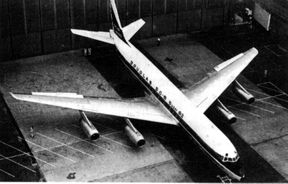
The DC-8's development had been agonizingly slow by the standards of a company that had produced the DC-3, DC-6, and DC-7 in rapid succession and had owned the commercial airliner market for two decades. Douglas's leadership had hesitated to commit to jet transport development in the early 1950s, convinced that the piston-engine market had years of life remaining and reluctant to cannibalize sales of the highly profitable DC-7 family.
By the time Douglas formally launched the DC-8 program in 1955, Boeing had already been flying its 707 prototype for a year, and the head start proved difficult to overcome in the race for airline orders. Yet the DC-8 that eventually emerged had genuine competitive advantages of its own: its cabin was slightly wider than the 707's, providing more comfortable six-abreast seating, and its wing design gave it outstanding range characteristics that made it particularly attractive for transoceanic operators.
Pan American, which had famously placed simultaneous orders for both the 707 and the DC-8 in 1955 in a masterstroke of competitive leverage against both manufacturers, helped validate the DC-8 as a serious rival to Boeing's offering. The DC-8's most remarkable achievement came not at its introduction but a decade into its career, when Douglas developed the Super Sixty series variants the DC-8-61, -62, and -63 that stretched the original fuselage by up to 37 feet, creating what were at the time the longest commercial aircraft in the world and capable of carrying up to 259 passengers.
The -63 variant in particular, combining the stretched fuselage with more powerful engines and an extended wing, became one of the most capable long-range heavy transports in the world, serving airlines on demanding routes for decades. When McDonnell Douglas the company formed by the 1967 merger of Douglas and McDonnell Aircraft eventually retired the DC-8 from new production in 1972 after 556 aircraft, many of the stretched Super Sixties were re-engined with modern high-bypass turbofans in the 1980s and continued flying cargo operations well into the twenty-first century, making the DC-8 one of the longest-serving commercial jet airframes in aviation history and a fitting final chapter in the story of the company that had done more than any other to shape commercial aviation in the propeller age.