U.S. Orders B-52 Bombers
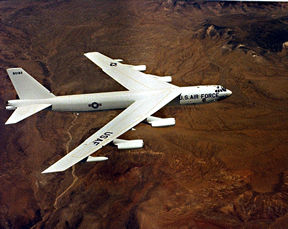
On March 1, 1951, the United States Air Force placed its production order with Boeing for the B-52 Stratofortress, the eight-engine swept-wing heavy bomber that was designed to replace the massive Convair B-36 Peacemaker as the backbone of Strategic Air Command's nuclear deterrent. The aircraft that Boeing had been developing since the late 1940s was a machine of extraordinary capability: powered by eight Pratt and Whitney J57 turbojet engines mounted in four twin-engine pods beneath its dramatically swept wings, capable of carrying a bomb load of 50,000 pounds, and possessing a range of 15,000 miles that allowed it to strike targets anywhere on earth from bases in the continental United States without refueling.
Its development had not been straightforward — the design went through numerous radical revisions, including a famous episode in October 1948 when the Boeing design team checked into a Dayton, Ohio hotel and over a single weekend completely redesigned the aircraft from a straight-wing turboprop configuration to the swept-wing pure-jet design that was actually built, delivering a hand-carved balsa wood model to Air Force officials at the end of that weekend.
The B-52 entered operational service with Strategic Air Command in 1955, and at the height of the Cold War hundreds of the aircraft flew continuous airborne alert missions, each carrying thermonuclear weapons, ensuring that a Soviet first strike could never eliminate America's ability to retaliate. The B-52 Stratofortress has compiled a service record without parallel in the history of military aviation, and what makes it truly extraordinary is not what it accomplished in its first decades but that it is still accomplishing it today — more than seventy years after that production order was placed.
The aircraft flew its first combat missions during the Vietnam War, dropping conventional bombs from high altitude in the massive Arc Light strikes that reshaped the ground war in Southeast Asia, and it has been in continuous combat employment ever since: in Operation Desert Storm in 1991, in Afghanistan beginning in 2001, and in Iraq in 2003, where B-52s flying from Diego Garcia in the Indian Ocean delivered precision-guided munitions with an accuracy that the aircraft's original designers could not have imagined.
Each successive generation of avionics upgrades, engine improvements, and weapons systems integration has kept the B-52 relevant in an era of stealth fighters and hypersonic missiles that would have seemed like science fiction when the first production aircraft rolled out of Boeing's Seattle plant in the mid-1950s. The United States Air Force currently operates 76 B-52H aircraft, the final production variant delivered between 1960 and 1962, and has committed to keeping them in service through at least 2050 — meaning that individual airframes will have served for nearly a century by the time they are retired.
No other military aircraft in history has matched, or is likely to match, that record of longevity and continuous relevance, making the B-52 Stratofortress not merely America's most durable bomber but arguably the most successful military aircraft ever built.